We went all in.
Cursor. Copilot. Claude. Every tool that promised to make our engineers faster, we adopted it. We were early, we were enthusiastic, and we were convinced that AI was the unlock we had been waiting for.
For a while, it felt like it was working.
Output went up. Pull requests came in faster. Features that used to take two weeks were getting done in three days. On paper, everything looked better.
And then we looked at delivery.
Releases were still slipping. Rework was still piling up. Architectural decisions were still being made inconsistently across teams. The same conversations we had been having for years, about predictability, about quality, about why things always felt like a scramble at the end of every sprint, were still happening.
The tools made our engineers faster. They did not make our delivery better.
That told us everything.
The insight that changed how we think about software delivery
AI has made code abundant. What it has not made abundant is structure.
When you give a team AI tools without a governing system underneath them, output accelerates but so does everything else, the drift, the inconsistency, the architectural decisions made differently by different people on different days. AI-generated code still needs to conform to standards. Pipelines still need to be designed and enforced. Knowledge that used to live in a senior engineer's head still needs to live somewhere.
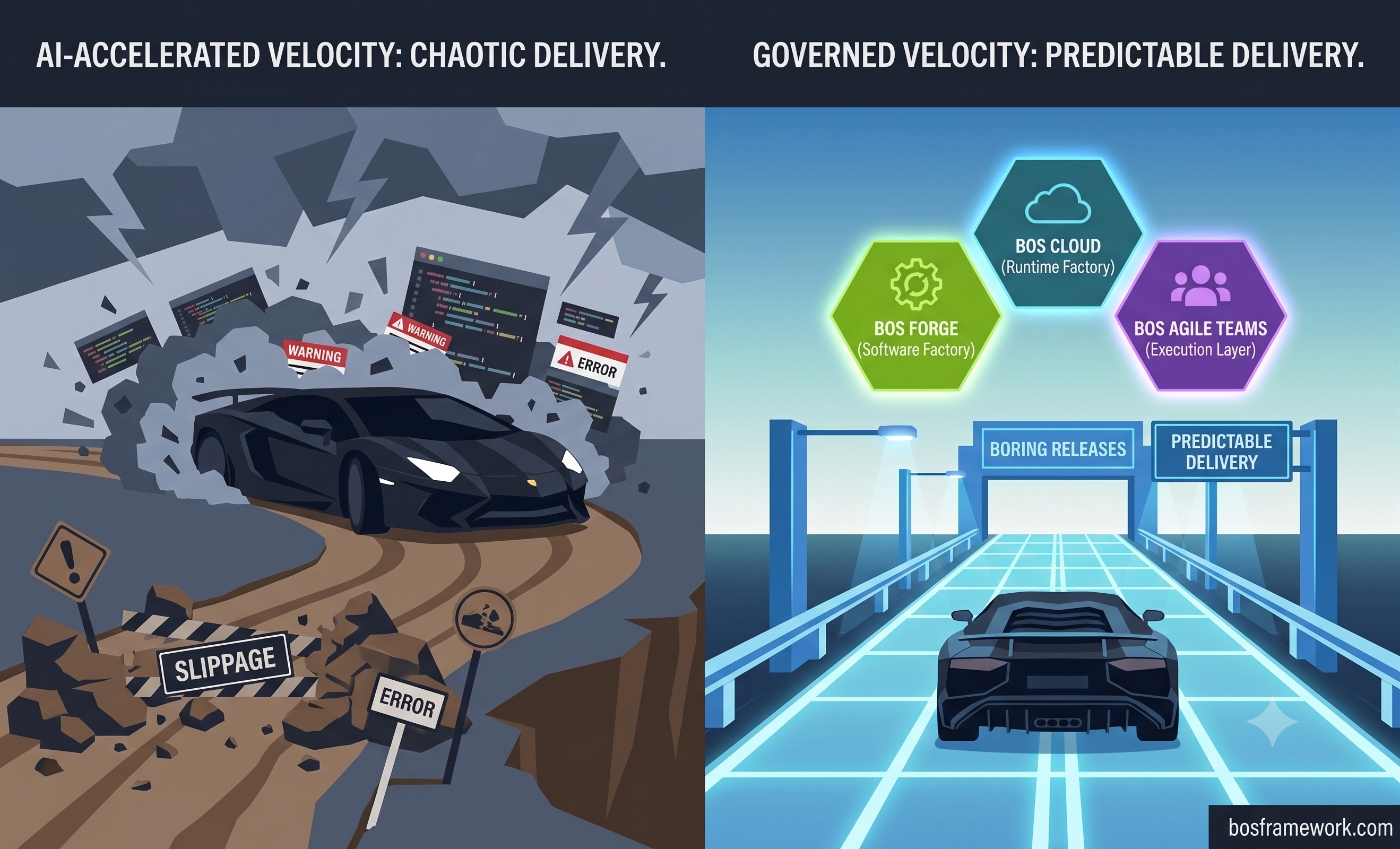
Speed without structure does not get you to the destination faster. It gets you to the problem faster.
We had spent years watching engineering organizations struggle with exactly this. Brilliant teams, good intentions, and a delivery process that ran on heroics. Individual engineers carrying the system in their heads. Releases that felt like events. Deployments that required the one person who "just knows how everything connects."
The constraint was always the same, the absence of a system to govern how software actually gets built, deployed, and operated.
So we built one. We call it the Operating System for Software Delivery. And it is delivered through three integrated components, the BOS Triad.
BOS Forge: the Software Factory
Forge is where software delivery becomes deterministic.
It structures the entire SDLC, from vision formalization and business requirements through architecture, data modeling, technical specifications, and governed AI-accelerated code generation. Every stage includes enforced human validation. Every output is traceable, repeatable, and architecturally consistent.
AI accelerates every layer of Forge. But it operates inside guardrails, not as a freeform prompt engine, but as a governed participant in a structured process. The result is production-grade software generated predictably, without the rework cycles and architectural drift that come from improvisation.
When we installed Forge, the all-nighters stopped. Releases became boring. That was the goal.
BOS Cloud: the Runtime Factory
Getting the code right is only half the equation. How that code lands in infrastructure matters just as much.
BOS Cloud replaces fragile, manual cloud operations with deterministic, blueprint-based provisioning. Environments are built from validated architectural patterns that embed security, observability, and cost governance by default. Compliance posture is continuous, not a fire drill at audit time. Drift is monitored and controlled automatically.
In an AI-accelerated world, infrastructure sprawl is a real and growing risk. Cloud provisions in minutes now. Without governance, that speed creates chaos faster than any team can manage. BOS Cloud makes sure the runtime environment is as governed as the delivery process above it.
BOS Agile Teams: the execution layer
Tools and systems still require people to operate them. But the kind of people, and how they work, changes completely when there is a system underneath them.
BOS Agile Teams are cross-functional delivery pods, architecture, engineering, DevSecOps, security, compliance, and QA, operating natively inside the BOS Software Factory model. Because every team member works within the same deterministic framework, there is no vendor fragmentation, no dependency on isolated experts, and no variability from improvisation.
The team does not carry the system in their heads. The system carries itself. The team executes inside it.
This is what it looks like when an engineering organization scales without scaling the chaos.
What this means for engineering leaders right now
Every CTO we talk to is under pressure to show their organization is embracing AI. The tools are genuinely good, we are not suggesting otherwise. But adopting AI without building the system underneath it is like handing a fast car to a driver with no road.
The engineering organizations that will win in an AI-accelerated world are the ones that have built a governing system disciplined enough to make those tools deliver. One where code is generated inside architectural guardrails. Where infrastructure provisions compliant by default. Where teams execute inside a framework instead of improvising around one.
That is what the BOS Triad installs. And it is what we learned when we gave our team every AI tool available.
Boring releases. Predictable delivery. Every time.
Ready to build the system underneath?
Learn how BOS Framework helps engineering organizations govern delivery at scale, with or without AI.
Explore BOS Framework